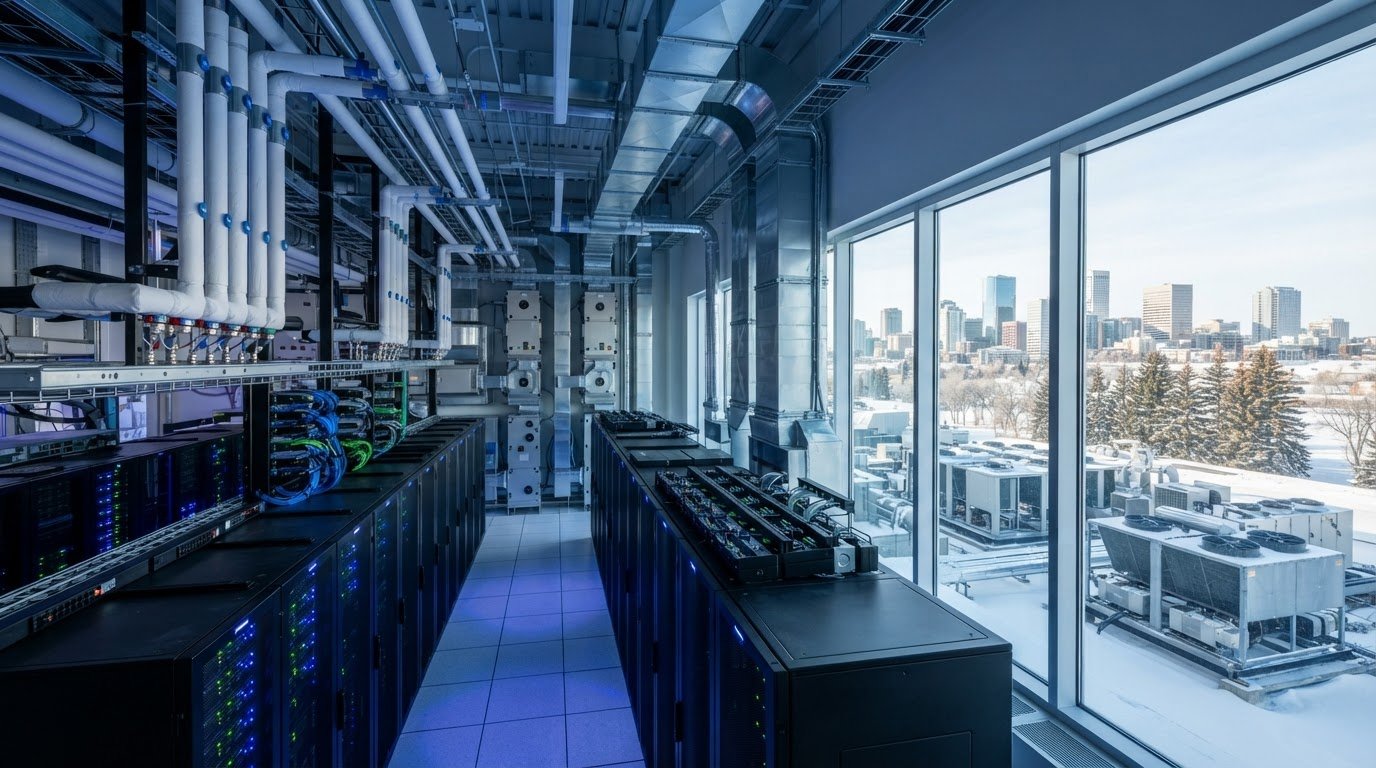
Edmonton’s cold winters don’t make data-center cooling simple. They make year-round planning more important. A dependable plan for climate control systems for data centers Edmonton facilities rely on must account for changing outdoor conditions, equipment heat loads and the consequences of a cooling failure. Cooler weather may create opportunities to reduce mechanical cooling, but it doesn’t replace careful design, controls or backup planning.
Choosing a system means balancing reliability, energy use, space, power and future growth. This guide explains the main components of data-center climate control and compares air cooling, liquid cooling and economizer-assisted operation. It also covers how Edmonton’s climate affects system planning, why mechanical and electrical coordination matters, and how monitoring and maintenance support day-to-day operation. Use the practical checks below to build a clear project brief and compare options against your facility’s actual needs.
Key Takeaways
- Cooling, airflow, humidity control and monitoring work together to protect servers and supporting electrical equipment.
- Compare air cooling, liquid cooling and economizer-assisted operation against workload, design requirements and maintenance needs.
- Assess climate control systems for data centers Edmonton facilities need by starting with load profiles, reliability goals, available power and future growth.
- Factor Edmonton’s seasonal conditions into cooling design, while planning for reliable operation throughout the year.
- Coordinate mechanical, electrical, controls and ductwork planning, then carry those decisions through commissioning and ongoing maintenance.
Climate Control Systems for Data Centers in Edmonton: What They Must Protect
A data center needs a different heating and cooling plan from an office. Servers and supporting electrical equipment generate heat continuously, and uneven airflow can expose some equipment to hot spots even when the room feels cool. The right climate control systems for data centers Edmonton facilities rely on are designed around equipment loads, airflow paths and operating requirements, not room comfort alone.
Data-center climate control coordinates cooling, airflow, humidity, monitoring and environmental protection to keep technology equipment within its intended operating conditions. Ordinary commercial air conditioning serves people and general spaces. Data-center thermal management directs heat away from sensitive equipment and supports the facility’s availability objectives. The Data center climate control overview also explains the role of environmental control in data-center design.
Cooling equipment is only one part of the plan. Air distribution, sensors and control sequences determine where cooling goes and how the facility responds as equipment loads or outdoor conditions change.
To see how liquid-cooling equipment can fit into a data-center design, watch this overview:
What does a data-center climate-control system include?
Depending on the design, the system may include cooling equipment, supply and return air paths, ductwork or other distribution components, controls, sensors and equipment that rejects heat outdoors. Fans and air pathways need to deliver cooling to equipment intakes and carry warmed air back for treatment. The room layout and heat load guide the configuration. A change in rack arrangement or workload can require a different airflow plan.
Why do reliability and environmental control matter?
Cooling continuity supports server operation, but reliability means more than having cooling equipment in the building. The design should reflect the facility’s availability objectives, including how the system is monitored and how it responds when conditions change. Humidity and other environmental factors matter too: equipment needs a controlled operating environment, not simply a comfortable room temperature.
Airflow deserves close attention. Obstructed paths, poorly directed supply air or mixing between hot and cool air can create local hot spots. Room-level readings may not reveal them, so sensor placement and monitoring should provide useful visibility around equipment areas. Controls can then support a measured response instead of guesswork.
Edmonton’s outdoor climate may create opportunities to use cooler air as part of a cooling strategy, but the weather is not a control system. Conditions change, and outside air alone cannot reliably manage equipment heat. A sound operating plan accounts for seasonal variation, directs cooling where it is needed and supports continuous operation through changing conditions. That distinction is central to a resilient facility-wide approach.
How Edmonton Data-Center Cooling Systems Move and Remove Heat
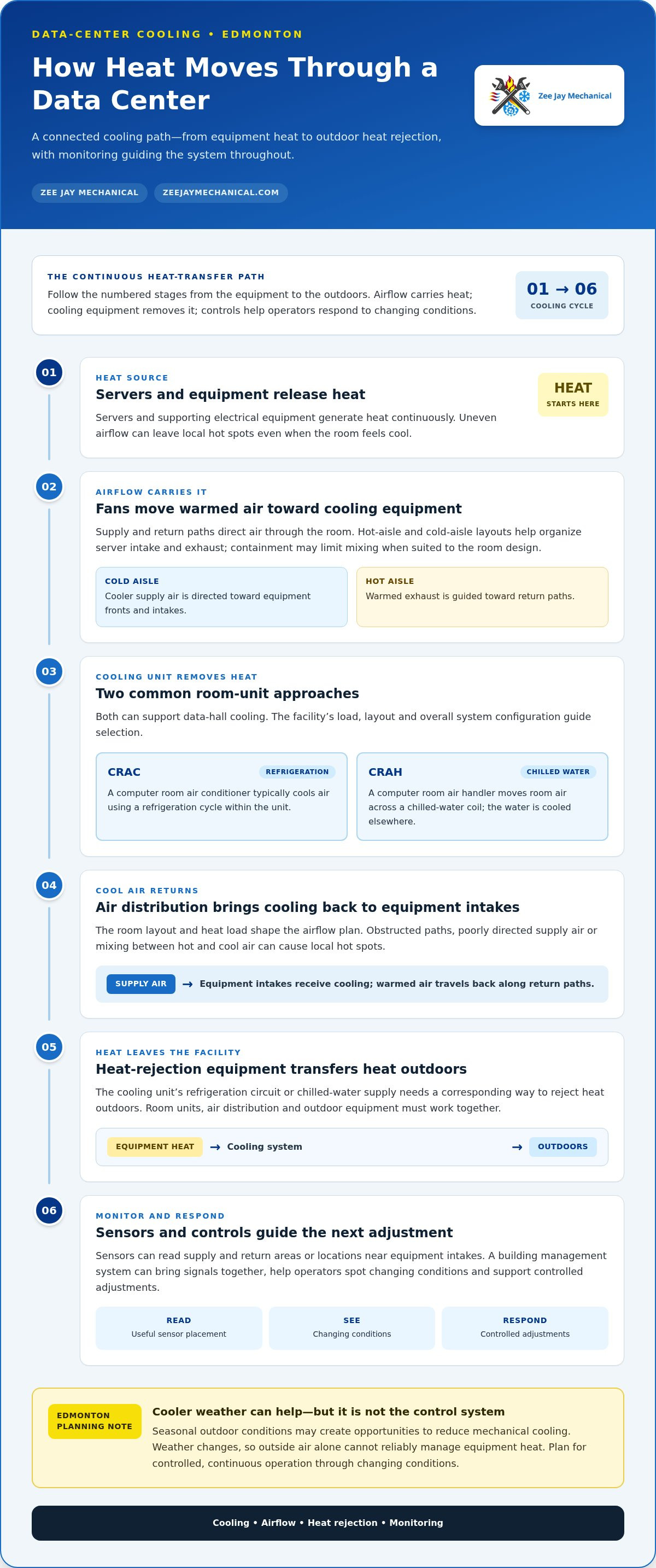
Cooling works as a continuous heat-transfer path. Servers and other equipment release heat into the surrounding air. Fans move that warmed air toward cooling equipment, which removes heat before supplying cooler air back to the equipment. The heat then travels through the facility’s chosen heat-rejection system to the outdoors. If one part of this path is poorly matched to the others, room cooling can become uneven or difficult to manage.
Airflow carries equipment heat to cooling units, controls guide the system’s response, and heat-rejection equipment moves that heat out of the facility. A data-center design therefore treats room units, air distribution, monitoring and outdoor equipment as a connected system, rather than treating air conditioning as a standalone appliance.
How do CRAC and CRAH systems differ?
A CRAC is a computer room air conditioner. It typically cools air using a refrigeration cycle within the unit, much like a packaged cooling system. A CRAH, or computer room air handler, moves room air across a chilled-water coil. The water is cooled elsewhere in the system. Both can support data-hall cooling, but neither is the universal choice. The facility’s load, layout and overall system configuration guide selection.
The distinction matters because room equipment is only one stage. A CRAC’s refrigeration circuit or a CRAH’s chilled-water supply needs a corresponding way to reject heat outdoors. Equipment sizing, air distribution and the wider mechanical design must work together to deliver cooling consistently to the racks.
Where do airflow, controls, and heat rejection fit?
Hot-aisle and cold-aisle layouts organize server intake and exhaust so cooler supply air reaches equipment fronts while warmed exhaust moves toward return paths. Containment can help limit mixing, but its suitability depends on the room design. Poorly placed openings, obstructions or mismatched supply and return paths can allow hot air to recirculate. Local hot spots may result even when average room conditions appear acceptable.
Sensors provide readings at selected points, such as supply and return areas or near equipment intakes. A building management system can bring those signals together, help operators spot changing conditions and support controlled adjustments to cooling operation. Useful monitoring depends on sensor placement and clear response procedures, not simply on collecting data.
Heat rejection deserves equal attention. Depending on the design, heat may be transferred outdoors through equipment such as condensers, dry coolers or cooling towers. The chosen approach affects operation across Edmonton’s changing seasons and must be coordinated with room cooling. Outdoor air can support some operating strategies, but the system still needs to manage equipment heat, operating transitions and changing conditions.
For Edmonton facilities, planning climate control systems for data centers Edmonton requires coordination across mechanical systems, power distribution, controls and ductwork. Zee Jay Mechanical provides commercial HVAC maintenance and mechanical and electrical engineering support. Learn more about its commercial HVAC and engineering support.
Air Cooling, Liquid Cooling, or Economizers: Compare Edmonton Options
No single cooling approach suits every data center. Air systems, liquid systems and economizer-assisted operation handle heat differently. Their fit depends on equipment density, facility design, controls and operating priorities. Edmonton’s cold weather can help reduce mechanical cooling demand under suitable conditions, but it doesn’t eliminate the need for engineered cooling. Servers produce heat year-round, and outdoor conditions change.
Use this comparison to narrow the options. The right choice depends on how each approach fits the full facility, including heat rejection, maintenance access and operating procedures.
| Approach | Potential fit | Design dependencies | Operational considerations and limits |
|---|---|---|---|
| Air cooling | Equipment loads that can be managed by directed room airflow | Rack arrangement, air distribution, cooling-unit capacity and separation of supply and return air | Familiar system approach, but hot spots or higher heat density can challenge airflow and cooling delivery |
| Liquid cooling | Higher-density workloads or equipment designed to transfer heat to liquid | Cooling distribution to the equipment, facility interfaces and a compatible heat-rejection path | Requires planning for integration, leak management, maintenance and staff procedures; the system still needs to reject heat |
| Economizer-assisted operation | Facilities able to use suitable outdoor conditions to reduce mechanical cooling demand | Outdoor-air or heat-exchange arrangement, filtration, humidity management and control sequences | Benefit varies with weather and system design; outdoor conditions alone cannot provide continuous, controlled cooling |
When can air cooling or liquid cooling make sense?
Air cooling can be practical when the equipment load and room layout allow supply air to reach equipment effectively and warmed air to return without excessive mixing. Liquid cooling, including direct-to-chip arrangements, transfers heat from compatible equipment more directly and may suit higher-density workloads. Neither approach is automatically simpler or better. Compare workload, equipment compatibility, integration needs, heat rejection, maintenance tasks and operating procedures before selecting a system.
Can Edmonton’s cold climate support economizer operation?
Yes. Suitable outdoor conditions can support economizer operation and reduce reliance on mechanical cooling. But Edmonton’s seasons bring changing temperatures and conditions, so the design needs clear operating sequences for when to use outdoor air, when to transition and how to maintain equipment conditions. Filtration and humidity management matter too, particularly when outside air enters the facility. Suitability and potential savings require project-specific engineering verification.
Cold weather is an opportunity, not a safeguard. Outdoor air can be too warm, too cold or unsuitable for direct use, while servers continue producing heat. A dependable design accounts for those shifts and includes a controlled cooling method for conditions when economizer operation isn’t appropriate. For climate control systems for data centers Edmonton facilities are planning, compare options against actual workloads and operating requirements, not the winter forecast alone.
How to Evaluate Climate Control Systems for an Edmonton Data Center
Start with the facility’s operating needs, not a shortlist of equipment. Work through the decisions in order so cooling capacity, electrical systems, controls and maintenance plans support the same goals. This process also surfaces assumptions that could affect future expansion or seasonal operation.
Which project requirements should shape the design?
Document what the cooling system must support before comparing configurations. Facility requirements connect equipment loads to room layout, power supply and the operating plan. Use this sequence to create a clear design brief:
- Define the workload. Record current and planned IT loads, equipment types, rack density and expected changes. Note areas with different heat profiles instead of relying only on a facility-wide average.
- Set reliability objectives. Establish the owner’s availability goals, acceptable maintenance windows and response expectations. Use these priorities to guide redundancy planning and define how the facility should operate during maintenance or equipment failure.
- Coordinate space and power. Review available electrical capacity, cooling equipment locations, distribution routes and maintenance access. Cooling demand and electrical design are linked, so coordinate power-distribution needs with mechanical requirements early.
- Plan for growth and service. Identify where future racks or equipment could go, and consider whether the design can adapt without disrupting current operations. Include practical access for inspection, repairs and routine maintenance.
- Specify monitoring and response. Decide which conditions operators need to see, where sensors should be located and how alarms or control sequences should support a measured response. Assign responsibility for reviewing readings and acting on them.
How should Edmonton conditions affect system selection?
Include Edmonton’s winter and summer conditions in the design assumptions, but don’t choose a system based on a typical season alone. The project team should assess operating conditions using project-specific engineering data, including seasonal transitions and expected facility loads. Define how controls will shift between operating modes, respond to changes in equipment demand and maintain fallback operation if a preferred mode becomes unsuitable.
Outdoor conditions influence cooling strategy, but they don’t replace capacity planning, monitoring or clear operating procedures. The design should account for equipment changes, maintenance activities and what happens if a component is unavailable. This makes seasonal operation part of the reliability plan rather than an informal expectation.
Applicable Alberta and local code requirements can depend on project scope and system details. Have qualified project professionals verify the relevant requirements during design and permitting coordination, rather than relying on assumptions carried over from another facility. This helps align the mechanical plan with the building and electrical work.
For an Edmonton project, evaluating climate control systems for data centers Edmonton means connecting facility requirements to practical design, operations and maintenance. Zee Jay Mechanical provides commercial mechanical and electrical engineering services, automation, power-distribution design and commercial HVAC maintenance. Read this commercial HVAC repair and service guide for related system information, or learn about Zee Jay Mechanical’s commercial HVAC support.
From Design Coordination to Ongoing Data-Center HVAC Support in Edmonton
A dependable cooling plan takes more than selecting equipment. It moves from documented requirements to coordinated engineering, installation planning, commissioning and ongoing care. At each handoff, preserve the same design intent: systems need to work together, operators need to understand how to respond, and maintenance tasks need to fit the facility’s operating priorities.
What should project teams coordinate before commissioning?
Bring mechanical, electrical, controls and ductwork planning together early. Cooling equipment needs suitable power and space, airflow paths must align with the room and rack arrangement, and maintenance access must be practical. A change to one part of the design can affect another. For example, revised duct routes may alter airflow or restrict access needed to service nearby equipment.
Before commissioning, define what the system is expected to do and how the team will verify it. Commissioning checks operation against documented project requirements, including control sequences, alarms and system responses. It should also leave operators with useful records, not just a completed installation. Document operating procedures, alarm meanings, escalation responsibilities and maintenance expectations so staff know what to do when conditions change.
Clear coordination can reduce gaps between design and daily operation. Mechanical and electrical engineering, power-distribution planning, automation and custom ductwork all influence how the cooling strategy is delivered. Treat them as connected work, with decisions and responsibilities recorded as the project progresses.
How does ongoing service support dependable operation?
Once the facility is running, scheduled inspections and maintenance help teams identify developing issues before they disrupt normal operation. The maintenance plan should reflect installed equipment, operating conditions and access requirements. Routine checks can include reviewing system condition, control operation, airflow and monitoring points, with findings recorded for follow-up.
Automation and monitoring give operators visibility into system conditions and can support controlled responses. They don’t guarantee uptime on their own. Their value depends on appropriate sensors, useful alarm settings, clear responsibility for reviewing alerts and procedures that guide the next step. Pair monitoring with maintenance and response planning to make system information actionable.
Edmonton-based Zee Jay Mechanical provides commercial HVAC maintenance, mechanical and electrical engineering services, power-distribution design, automation and custom ductwork fabrication. These capabilities support coordination across a facility’s mechanical systems. For broader local HVAC context, the heating and air conditioning guide covers seasonal system considerations.
For climate control systems for data centers Edmonton projects, carry the design intent through commissioning and into regular operations. Talk with Zee Jay Mechanical about commercial HVAC support as you plan coordinated mechanical and maintenance needs.
Set the Next Design Decision in Motion
Turn your facility’s priorities into a working design brief. Record which assumptions need engineering review, who owns each decision and what changes in IT load or operating needs should trigger a reassessment. This gives project discussions a practical reference and helps keep future upgrades aligned with the facility’s reliability goals.
Planning for climate control systems for data centers Edmonton facilities depend on continues after installation. Build review points into operations so teams can learn from monitoring, maintenance findings and changes in equipment demand. That feedback helps keep the cooling strategy relevant as the facility evolves instead of treating the original design as fixed.
Zee Jay Mechanical provides commercial mechanical support in Edmonton for project planning and ongoing system needs. Discuss your Edmonton commercial mechanical project with Zee Jay Mechanical and take the next step toward a clear, coordinated plan.
Frequently Asked Questions
What is the difference between a CRAC and a CRAH unit?
A CRAC unit cools room air using a refrigeration cycle, while a CRAH unit moves air across a chilled-water coil supplied by another part of the cooling plant. That difference affects the supporting equipment the facility needs: a CRAH depends on chilled-water infrastructure, while a CRAC has refrigeration components at the unit. Neither acronym describes the whole cooling system, so compare the full design, not just the room unit.
Can Edmonton’s cold climate cool a data center without mechanical cooling?
No. Outdoor cold alone isn’t a dependable cooling plan. Servers produce heat continuously, and changing conditions can make outside air unsuitable or require a different operating mode. For example, winter operation needs controls that account for low outdoor temperatures and protect equipment from unsuitable conditions. Climate control systems for data centers Edmonton operators plan should include an engineered way to maintain equipment conditions when outdoor-air cooling can’t meet the facility’s needs.
Is liquid cooling better than air cooling for a data center?
Not in every facility. Liquid cooling may suit equipment designed for it or workloads that concentrate more heat in a smaller area. Air cooling can work when room airflow can serve the equipment load. Compare hardware compatibility, maintenance access, staff procedures and the facility’s heat-rejection design. A mixed approach may also be considered, but it adds coordination needs. The right choice depends on the workload and operating plan, not the technology label alone.
How much redundancy does a data-center cooling system need?
Redundancy should match the owner’s availability objectives and the consequences of losing cooling capacity. An N+1 arrangement, for example, includes an additional unit beyond the number needed for the design load. It’s one approach, not a universal requirement. The review should also cover shared dependencies such as power, pumps, controls and heat rejection. A backup unit won’t provide meaningful resilience if a common failure can disable it and the primary system together.
What does PUE mean for data-center cooling decisions?
PUE, or Power Usage Effectiveness, compares total data-center energy use with the energy used by IT equipment. It can help teams understand facility overhead, including energy used by cooling and electrical support systems. PUE isn’t a cooling-efficiency score on its own, and comparisons can be misleading if workload, weather or measurement boundaries differ. Track it alongside equipment performance and operating conditions to assess whether a design change is helping.
How often should data-center cooling equipment be maintained?
There isn’t one maintenance interval that suits every system. Set the schedule using the equipment manufacturer’s instructions, design requirements, operating conditions and maintenance history. A practical programme assigns responsibility for inspections, records findings and tracks recurring alarms or performance changes. For instance, repeated filter concerns or unusual operating trends can prompt investigation rather than waiting for a scheduled service date. Keep maintenance records available to operators and project teams.
Can economizers operate year-round in Edmonton?
They may operate during suitable conditions, but year-round economizer use shouldn’t be assumed. The system needs controls that determine when outdoor conditions are appropriate and when to transition to another operating mode. Design review should account for seasonal changes, air quality, filtration and humidity control, along with mechanical cooling as a fallback. Whether year-round operation is practical depends on the specific facility, equipment and engineering analysis.
Disclaimer
The content of this article is for the general information purpose. Please contact us if you have any questions.