
What if the best HVAC service contract isn’t the one promising the biggest savings? When deciding what to look for in an HVAC service contract, clear answers about maintenance visits, repair coverage, exclusions, and emergency response matter more than broad promises. Without those details, it’s hard to know what you’re paying for or how the agreement applies when a furnace or air conditioner needs attention.
Dependable support without surprises is a reasonable goal. This guide explains how to compare contract scope, visit schedules, included repairs, excluded work, and response terms, then weigh an agreement against paying for service as needed. Use these criteria to assess whether the written terms suit your Edmonton home or business and its HVAC equipment.
Zee Jay Mechanical serves residential and commercial HVAC customers in Edmonton, with Red Seal Certified technicians and a 24/7 emergency line with round-the-clock support. These are useful details to consider, but the agreement itself should still spell out its coverage. Your comfort is our priority.
Key Takeaways
- An HVAC service contract is a written agreement, but a plan name alone doesn’t explain what maintenance, repairs, or response support it includes.
- Compare the equipment covered, the specific maintenance tasks, and the visit schedule. Check these separately from parts, repairs, emergency calls, and exclusions.
- Use this guide to understand what to look for in an HVAC service contract and compare agreements against the same criteria.
- A contract isn’t automatically better value than paying as needed. Weigh its written fee against included work and any separately billed services.
- ZeeJay Mechanical provides Edmonton HVAC support, Red Seal Certified technicians, and a 24/7 emergency line. Your comfort is our priority.
What an HVAC service contract covers, and what it does not
An HVAC service contract is a written agreement describing specific heating, ventilation, and air conditioning services, the equipment they apply to, and the terms for providing them. That definition is a useful starting point, but the agreement’s details determine its actual scope.
Labels such as “maintenance plan” or “service agreement” don’t guarantee the same coverage. One contract may focus on scheduled inspections, while another may set out repair benefits or emergency response terms. Read the written scope rather than relying on the plan name, a summary, or a broad promise of “full service.” Preventive maintenance does not automatically include parts, corrective repairs, or urgent service calls.
Keep maintenance and repair work distinct. Maintenance is planned system care; a repair call addresses a problem that has already developed. A maintenance visit might include specified inspection or cleaning tasks, while diagnosing a furnace that won’t start may be a separate service unless the agreement says otherwise. Maintenance can help identify issues, but it can’t prevent every breakdown or guarantee savings.
How a maintenance agreement differs from a repair call
Check that the agreement identifies each covered system, such as a furnace or air conditioner, rather than referring vaguely to “your HVAC.” Review the scheduled tasks and timing, then check whether troubleshooting, labour, parts, and follow-up repairs are included or billed separately. If the property has multiple systems, make sure the document names each one. Specific equipment descriptions help clarify which units a visit covers.
Why written scope matters for Edmonton properties
Edmonton’s heating and cooling needs make seasonal planning relevant. You may want furnace care ahead of colder weather and air conditioner attention before warmer months, but the agreement should state the actual schedule. Match its equipment list to what’s installed at your property: for example, a home’s furnace and air conditioner, or a commercial building’s rooftop unit and ductwork.
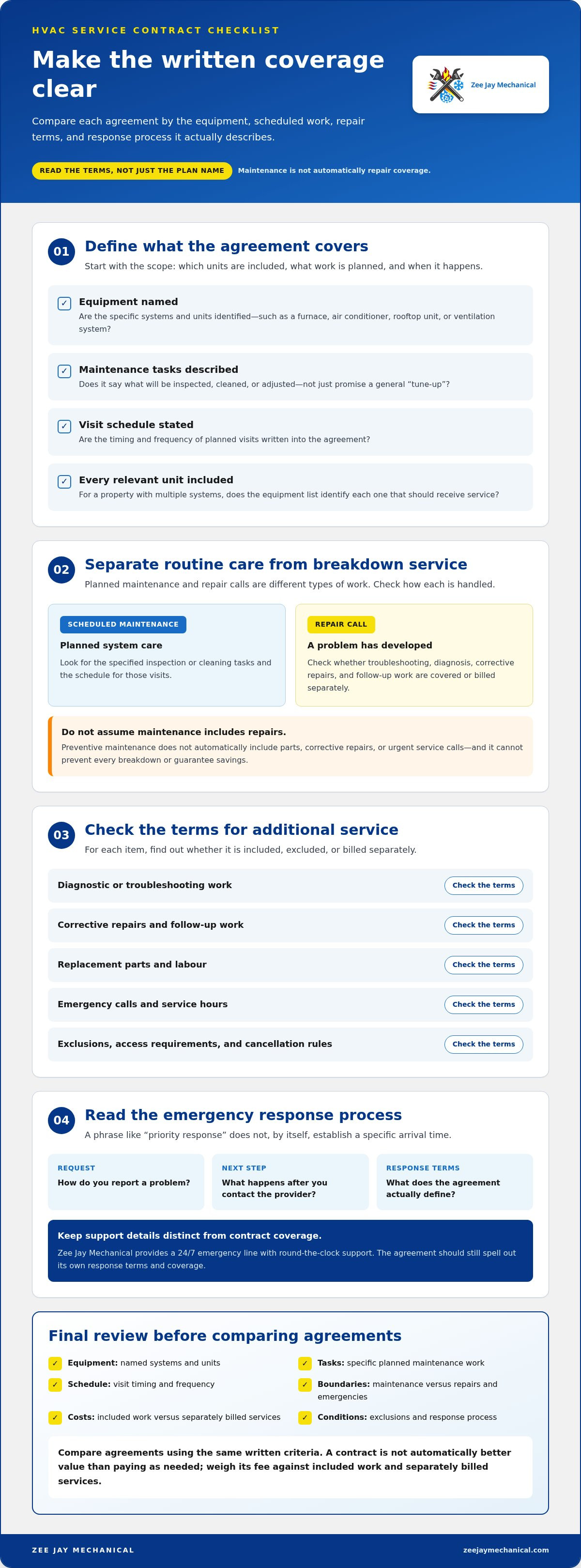
Before comparing agreements, use this quick scope check:
- Equipment: Are the specific systems and units identified?
- Tasks: Does the agreement describe the maintenance work, rather than simply promise a tune-up?
- Schedule: Are visit timing and frequency stated?
- Boundaries: Does it distinguish planned maintenance from breakdown diagnosis, repairs, and emergency calls?
This is the foundation of what to look for in an HVAC service contract: specific services tied to named equipment, with a clear line between routine care and additional work. ZeeJay Mechanical serves residential and commercial customers in Edmonton and provides a 24/7 emergency line with round-the-clock support. An emergency line is a support option, not a substitute for reading the agreement’s response terms. Your comfort is our priority.
Which maintenance, repair, and response terms should an HVAC contract spell out?
A useful agreement connects each promise to a piece of equipment, a specific task, or a defined service process. Compare the actual wording, not just the benefits highlighted in a plan summary. For a furnace, air conditioner, rooftop unit, or ventilation system, you should be able to tell what routine work is scheduled and what happens if the equipment needs attention between visits.
Check equipment, tasks, and scheduled visits
Start with the equipment list. The agreement should identify the covered system by type and, where relevant, distinguish between multiple units at the property. Then review the task descriptions: “inspection” alone may not explain what the technician will inspect, clean, or adjust. Match the stated tasks to your equipment. Visit frequency varies by contract, so look for the written schedule rather than assuming every agreement uses the same timing.
For example, an agreement that names a furnace but describes only general system maintenance may leave expectations unclear. More useful wording connects the unit to listed service tasks and explains when visits are planned. At a commercial property, check that relevant rooftop equipment or ventilation systems are identified individually, rather than relying on a broad reference to the building’s HVAC.
Read repair, emergency, and exclusion language
Separate scheduled maintenance from breakdown support. Check whether diagnostic work, corrective repairs, replacement parts, and emergency calls are included, excluded, or billed separately. Note any stated exclusions, access requirements, cancellation rules, and service hours. If a term is broad, such as “priority response,” look for the process it describes. The phrase alone doesn’t establish a specific arrival time.
Response wording should explain what happens when you report a problem. It may describe how to submit a request, what follows, or how the provider determines the next step. These details clarify the process without turning an emergency line into a promise of a particular arrival time. ZeeJay Mechanical provides a 24/7 emergency line with round-the-clock support. That support information is distinct from the response time or coverage defined in an individual contract. Your comfort is our priority.
Quick contract check: Locate the covered equipment, named maintenance tasks, visit schedule, repair and parts terms, emergency process, exclusions, access conditions, service hours, and cancellation rules.
Keep those details together as you compare options. ZeeJay Mechanical provides Edmonton HVAC support for residential and commercial customers, including inspection and repair services. The written contract remains the place to confirm what its terms cover.
How to compare HVAC service contracts for Edmonton homes and businesses
Put each agreement beside the same set of questions before judging its value. Plan names and benefit labels can sound similar while describing different work. A side-by-side comparison makes gaps easier to spot and keeps the focus on the systems and service needs at your Edmonton property.
| Comparison point | What to record |
|---|---|
| Scope | Named maintenance tasks, repairs, and other included services |
| Equipment | Systems and units covered, identified by type |
| Frequency | Visit schedule and any stated timing |
| Exclusions | Work, parts, or situations excluded from coverage |
| Response | How service requests are handled and any stated response terms |
| Renewal | Renewal, cancellation, and payment terms as written |
Compare residential and commercial coverage needs
At home, compare the agreement with the systems you rely on, such as a furnace, air conditioner, ductwork, or indoor-air-quality equipment. A business may need to account for rooftop units, commercial HVAC maintenance, and multiple systems serving different areas. Priorities can differ: homeowners may focus on planned service for their equipment, while businesses may consider how maintenance fits their operations. For related commercial context, explore this commercial HVAC services guide.
Use a like-for-like contract comparison
Compare equivalent work, not just similar-sounding plans. If one agreement lists specific maintenance tasks and another uses a general label, record the difference rather than treating them as equal. Write down renewal, cancellation, and payment terms exactly as stated; don’t assume standard conditions. For broader perspective on how comprehensive mechanical services are packaged, looking at established companies like All Types Plumbing, Heating & Air Conditioning LLC can serve as a helpful reference point.
Use the table as a working checklist. For each row, copy the agreement’s wording or summarize it without adding assumptions. Mark details that are absent or unclear, then compare only what the documents actually promise. This keeps a broad benefit label from standing in for a specific service and makes it easier to see whether agreements cover the same equipment and work.
For Edmonton homes, that could mean comparing the same furnace and air conditioner coverage across agreements. For a business, list each rooftop unit and check whether the stated maintenance applies to all of them. The goal is a fair comparison that reflects the property, not a quick ranking based on plan names. This approach makes what to look for in an HVAC service contract more concrete: scope, equipment, schedule, exclusions, response terms, and renewal details, all read side by side.
How to judge contract value, exclusions, and renewal terms before signing
A service contract isn’t automatically better value than paying for HVAC work as needed. Its value depends on whether the scheduled services suit your equipment and whether the written terms match the support you expect. Compare the stated fee with the included tasks and any separately billed work, rather than relying on a general promise of savings.
Use this review sequence before you decide:
- List the included work. Write down the maintenance tasks and visits the agreement specifically describes for your equipment.
- Separate extra charges. Note whether diagnostic work, repairs, replacement parts, or emergency calls are billed outside the agreement.
- Compare expected use. Consider which included tasks you expect to use during the term without assuming every possible repair is covered.
- Read the exclusions. Record the situations, equipment, or work the contract excludes, along with any stated service limits.
- Check renewal and cancellation. Locate the renewal period, notice requirements, cancellation terms, and payment schedule as written.
Estimate value without assuming savings
Start with the work, not the marketing label. A contract focused on scheduled maintenance may still leave breakdown diagnosis and repairs as separate charges. Compare the agreement’s stated fee and included tasks with the services you expect to use. If the terms don’t explain a charge or service boundary, mark it as unclear rather than assuming it’s included.
Review renewal, cancellation, and warranty wording
Renewal terms can affect how long you remain committed and what notice is required to end the agreement. Read those clauses alongside exclusions and payment terms, and keep a copy of the written agreement. Don’t assume routine maintenance guarantees manufacturer warranty coverage. ZeeJay Mechanical’s stated warranty wording is: Manufacturer warranty honoured. Don’t read that as a promise about every repair or contract.
Clear terms make it easier to weigh scheduled work against paying only when service is needed. As you consider what to look for in an HVAC service contract, focus on the actual scope, costs that may sit outside it, and conditions governing renewal. A lower fee may come with a narrower scope, while a broader agreement may include services you don’t expect to use. Compare the details that matter to your property.
For Edmonton HVAC support grounded in professional inspection and repair, connect with ZeeJay Mechanical. Your comfort is our priority.
Choose dependable HVAC service support in Edmonton
A clear contract matters, and so does knowing who will assess and work on your equipment. ZeeJay Mechanical serves residential and commercial HVAC customers in Edmonton. Its Red Seal Certified technicians and factory-certified technicians bring relevant credentials to the work. The company is fully licensed, bonded, and insured for residential and commercial HVAC projects in Edmonton, and its installations are code-compliant. These details describe the company’s services; they don’t replace the need to read an agreement’s specific coverage terms.
What service accountability looks like
Dependable support starts with understanding the issue and the equipment involved. When comparing providers, look for a clear explanation of the inspection and repair process. ZeeJay Mechanical assesses HVAC concerns and carries out professional repairs. Keep the written service details and relevant equipment information together so you can discuss the system and understand the work being considered.
Use the contract as the reference for what’s included. Technician credentials or emergency support don’t automatically add maintenance visits, parts, repairs, or response terms to an agreement. Keeping those details separate helps you consider both professional capability and the written scope.
What to expect when scheduling service
ZeeJay Mechanical follows this four-step service process: 1) Schedule Your Service, 2) Expert Inspection, 3) Professional Repair, 4) Final Comfort Check. It outlines the service sequence, not additional inclusions in a maintenance contract. The agreement still determines the covered equipment, work, and applicable terms.
For urgent support, ZeeJay Mechanical has a 24/7 emergency line with round-the-clock support. This is an available support channel, not a promise that every contract includes emergency service or a particular arrival time. Read the agreement’s response language separately to understand how its terms relate to the support process.
Before choosing HVAC support, review your comparison notes. Check that the agreement matches the systems at your Edmonton property, describes the work you expect, and spells out exclusions, separately billed services, and renewal terms. Consider the provider’s Edmonton services and process alongside the written agreement. That’s a practical way to apply what to look for in an HVAC service contract without confusing credentials with coverage.
If you’re ready to arrange service, schedule HVAC service in Edmonton with ZeeJay Mechanical. Your comfort is our priority.
Take the next step with confidence
Once you’ve reviewed the agreements, use your notes to guide a practical conversation about your home or business. Choosing an HVAC service contract is about finding support that fits your property, not signing simply because a plan sounds comprehensive. Being clear about your priorities can make the decision easier.
Think about how your building is used, which systems matter most to daily comfort, and what kind of support would help you plan ahead. These priorities offer a starting point for deciding whether to arrange maintenance, address a concern, or learn more about HVAC service. Choose the next step that fits your equipment and schedule.
For local HVAC support, schedule HVAC service with ZeeJay Mechanical in Edmonton. Take the decision one step at a time. Your comfort is our priority.
Frequently Asked Questions
What should an HVAC service contract include?
An HVAC service contract should identify the systems covered, the work provided, and the terms that shape service. Check that the wording distinguishes, for example, a furnace inspection from a repair to a furnace that has stopped working. Also note how the agreement handles service records or follow-up recommendations, if it says. These details help you understand what the document commits to before signing.
Is an HVAC service contract worth it?
It depends on whether the written services fit your equipment, priorities, and expected use. To judge what to look for in an HVAC service contract, consider how a home with a furnace differs from a business with several systems and different operating needs. Compare the agreement’s charges with its included work, then account for separately billed service. A contract may suit someone who values scheduled care, while paying as needed may suit another property owner better.
Does an HVAC maintenance contract cover repairs?
Not necessarily. Some agreements focus on preventive visits, while others may include defined repair work or parts. Look at what happens after an inspection identifies a fault: does the agreement describe diagnosis, corrective work, parts, and any extra charges? A maintenance visit that identifies a furnace issue doesn’t by itself mean the repair is included. The written terms define the boundary between routine care and repair service.
How often should HVAC maintenance be included in a service contract?
There isn’t one visit schedule that applies to every HVAC contract or property. Check the agreement for the stated frequency and timing, then consider whether visits align with your equipment and seasonal operating needs. For example, a property owner may plan furnace attention ahead of colder weather, while a business may need to coordinate service around building operations. Compare the schedule as written rather than assuming a standard number of visits.
Can an HVAC service contract guarantee emergency service?
A contract can only set out the emergency support and response commitments in its written terms. Look for how to report an urgent issue, which situations qualify, the service hours, and whether the agreement states a response window. Don’t treat phrases such as “priority service” as a guaranteed arrival time unless the contract clearly says so. An emergency phone line and a contract’s coverage are separate details, so read each on its own.
What should Edmonton homeowners and businesses compare in HVAC agreements?
Compare each agreement against the systems and practical needs at the property. A homeowner might note whether the terms suit the furnace, air conditioner, or indoor-air-quality equipment in use. A business should account for each relevant system and how service scheduling fits its operations. Also compare the agreement’s payment, renewal, and cancellation wording. Keeping a copy of each document and marking differences side by side helps make the decision easier to explain and review.
Disclaimer
The content of this article is for the general information purpose. Please contact us if you have any questions.