
What if the most efficient commercial HVAC unit on paper still delivers a weak return in your building? A realistic estimate of ROI on a high-efficiency commercial HVAC unit Edmonton property owners are considering depends on more than equipment ratings. Building schedules, heating and cooling loads, controls, ductwork, and maintenance all affect how much energy a system uses in practice.
It’s reasonable to question whether a higher upfront investment will lead to meaningful savings, especially when operating hours and energy use vary from one property to another. Edmonton’s cold winters and hot summers put different demands on heating and cooling equipment throughout the year. Start your comparison with the building’s utility bills and operating conditions, not a savings percentage that may not fit your site.
This article provides a practical framework for estimating annual energy savings, comparing them with project costs, and calculating simple payback without assuming a guaranteed return. It also explains how system design, controls, ductwork, and ongoing maintenance can shape real-world performance. Zee Jay Mechanical provides commercial HVAC maintenance, repair, engineering, automation, and custom ductwork services to help Edmonton businesses assess system needs and plan upgrades around their buildings.
Key Takeaways
- Estimate ROI using your building’s energy use, project scope, and operating conditions rather than relying on equipment ratings alone.
- Understand how controls, system sizing, airflow, ductwork, and maintenance can influence the savings a new unit delivers.
- Compare a like-for-like replacement with higher-efficiency equipment and broader system improvements using consistent assumptions.
- Apply a clear framework to assess ROI on a high-efficiency commercial HVAC unit using your bills, equipment records, and operating schedule.
- See how a project-specific review can connect building needs with commercial HVAC, engineering, automation, maintenance, and ductwork expertise.
What Determines ROI on a High-Efficiency Commercial HVAC Unit in Edmonton?
A higher efficiency rating can look compelling, but it doesn’t tell you exactly how much a building will save. The ROI on a high-efficiency commercial HVAC unit Edmonton property owners are considering depends on the existing system, the building’s heating and cooling demands, and how the equipment is operated and maintained.
Edmonton’s heating season makes local operating hours and seasonal loads important to the calculation. A system serving a continuously occupied space faces different demands from one in a business with shorter hours or changing occupancy. Compare operating periods and space use, rather than applying the same assumptions to every property.
For a quick overview of how efficient components can support HVAC performance, watch this video:
ROI, payback period, and lifecycle value are different measures
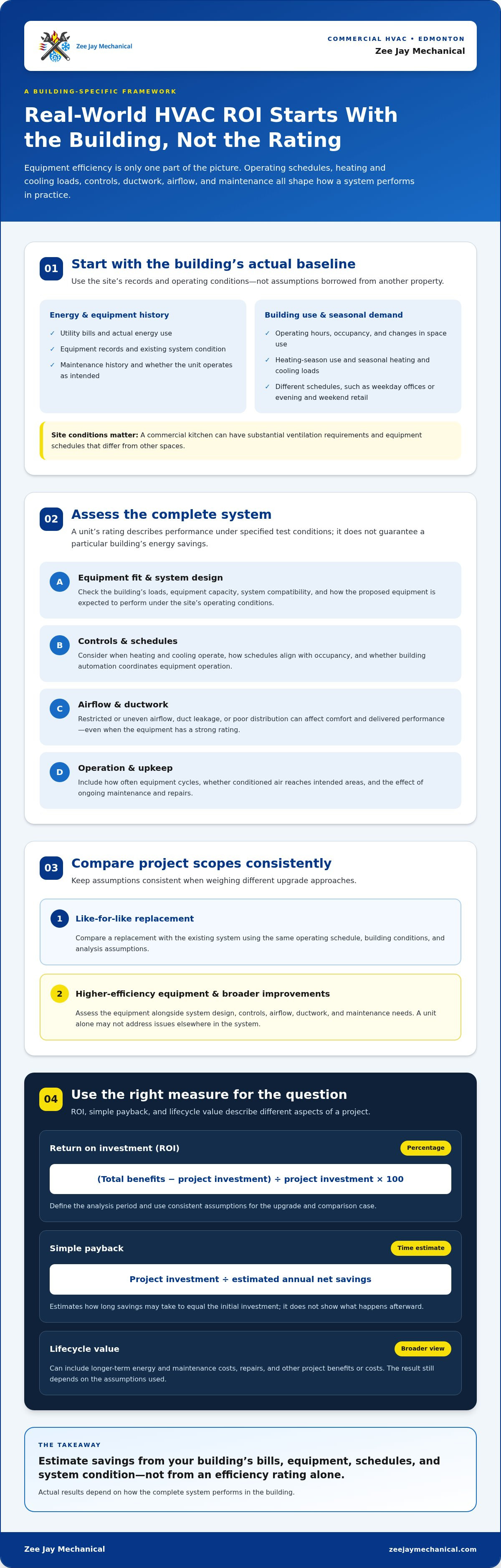
ROI expresses project benefits relative to investment as a percentage over a defined analysis period. A basic calculation is (total benefits minus project investment) divided by project investment, multiplied by 100. Use consistent assumptions for the proposed upgrade and comparison case, and state the analysis period so the result has context.
Simple payback is narrower: divide the project investment by estimated annual net savings. It estimates how long savings may take to equal the initial investment, but doesn’t show what happens afterward. Lifecycle value can include longer-term energy and maintenance costs, repairs, and other project benefits or costs. It offers a fuller view, but the assumptions still matter.
Why Edmonton building conditions change the calculation
Use utility bills, equipment records, operating schedules, and maintenance history to establish the building’s actual starting point. Account for heating-season use and changes in occupancy across the year. A projection based on another site’s hours or equipment condition may not reflect your building’s demands.
An office may follow a weekday schedule, while retail hours can extend into evenings or weekends. A commercial kitchen may have substantial ventilation requirements and equipment schedules that differ from other spaces. These differences affect system operation and the potential for savings.
An equipment efficiency rating describes performance under specified test conditions; realized building energy savings depend on how the complete system performs in the building. Controls, system design, duct condition, airflow, and ongoing maintenance all influence that result. A sound assessment compares expected equipment performance with site conditions rather than treating a rating as a savings guarantee.
Before drawing a conclusion, check whether the existing unit is operating as intended and whether the project scope addresses the whole system. Zee Jay Mechanical’s commercial HVAC maintenance and repair, engineering, automation, and custom ductwork services support a building-specific review of equipment needs and operating conditions.
How High-Efficiency Commercial HVAC Equipment Can Reduce Operating Costs
A high-efficiency unit may use less energy to deliver heating or cooling under suitable operating conditions. That potential matters most when the equipment is matched to the building’s load and works well with its controls and air distribution. An efficient unit can’t compensate on its own for poor airflow, unsuitable scheduling, or ductwork that prevents conditioned air from reaching the spaces that need it.
To assess operating costs, look beyond the unit. Consider energy use during occupied and unoccupied hours, how often the equipment cycles, and whether heating and cooling reach the intended areas. These details help explain why a rated improvement may not translate into the same reduction on a building’s utility bills.
Compare efficiency ratings with real operating performance
Equipment ratings provide a consistent way to compare units within the same category. They describe performance under defined test conditions, not every combination of outdoor temperature, building load, operating schedule, and control setting at a commercial property. Review manufacturer documentation and project specifications for the exact equipment being considered, and compare like with like.
Then relate those specifications to expected operating conditions. A unit may perform differently under a light load than when demand is high. If the building’s use changes by season or time of day, include that profile in the analysis. Rated efficiency alone cannot predict a building’s actual energy savings.
Include controls, ductwork, and maintenance in the system view
Controls affect when heating and cooling operate. Schedules aligned with occupancy can help avoid conditioning unused spaces longer than needed, while building automation can coordinate equipment operation. Any projected benefit should reflect the controls in place and how the building is managed.
Airflow matters, too. Restricted or uneven distribution can leave some zones uncomfortable while equipment continues running. Duct leakage, poor system compatibility, or a mismatch between equipment capacity and the building’s needs can also affect delivered performance. In a commercial kitchen, ventilation requirements add another layer to system operation and should be considered as part of the overall design.
Regular maintenance helps keep equipment operating as intended by addressing its condition and identifying developing issues. It shouldn’t be treated as a guaranteed source of savings. Instead, use realistic maintenance assumptions when comparing options, and account separately for potential operational benefits such as fewer interruptions or more consistent comfort. Those benefits can matter to a business, but they aren’t the same as measured energy savings.
For a practical review, bring together utility records, operating schedules, equipment information, and maintenance history. Zee Jay Mechanical’s commercial HVAC maintenance, engineering, automation, and custom ductwork services help connect those operating details with system needs. A review of commercial HVAC system performance can clarify which factors belong in an upgrade comparison before you estimate the ROI on a high-efficiency commercial HVAC unit Edmonton businesses are considering.
High-Efficiency Versus Like-for-Like Replacement: Compare the Full Project
A like-for-like replacement may appear less expensive because it keeps the project scope narrow. A higher-efficiency unit may use less energy, while broader system improvements may address controls, airflow, or ductwork as well. The right choice depends on the complete project and the building’s requirements, not the equipment label alone.
A higher-efficiency option isn’t automatically the better investment. Weigh its additional upfront cost against realistic operating savings and any added work. Compare options against the same building needs, operating schedule, and analysis period so the results aren’t skewed by different assumptions.
Build a fair equipment comparison
Start by defining what each option includes. Keep capacity and service requirements as consistent as possible, and use manufacturer documentation and project specifications to compare expected performance. Clearly identify assumptions, estimates, and differences in controls, installation scope, or commissioning requirements. Treat projected savings as estimates, not guarantees.
- Existing-equipment replacement: Replace the unit while keeping the broader system scope limited, where appropriate.
- Higher-efficiency replacement: Compare the proposed unit’s documented performance with the existing equipment and the building’s operating profile.
- Broader system improvements: Assess whether controls, ductwork, or other system work should be included alongside the equipment.
For each option, prepare a comparison table with these headings:
- Project scope, including equipment and related system work
- Expected energy use, with the assumptions behind the estimate
- Maintenance assumptions for the analysis period
- Analysis period used to compare costs and benefits
Account for project costs and operational risk
Purchase price is only one part of the investment. Use project-specific quotes to account for equipment, labour, installation scope, and applicable permitting. Include disruption assumptions, such as how the work schedule could affect normal building operations. These costs and effects may differ between a straightforward replacement and a wider system upgrade.
Maintenance, downtime, and remaining useful life can also influence the comparison, but include estimates only when supported by reliable equipment records and service history. For example, don’t assign a financial benefit to avoided downtime unless the business has a sound basis for estimating its impact. Keep these operational considerations separate from projected energy savings so the calculation remains clear.
Finally, test how the result changes under different conditions. Build low, base, and high scenarios by varying assumptions such as energy prices or operating hours. This sensitivity range shows whether an option remains attractive if actual use differs from the estimate. It also makes clear which assumptions have the biggest influence on the ROI on a high-efficiency commercial HVAC unit Edmonton property owners are evaluating.
Zee Jay Mechanical’s commercial HVAC, engineering, automation, maintenance, and ductwork services help connect equipment choices with the building’s wider system requirements.
How to Calculate Commercial HVAC ROI for an Edmonton Building
A useful ROI estimate starts with your building’s records, not a generic savings percentage. Separate what you know from bills and service documents from what you’re forecasting for a proposed project. This makes the assumptions visible and gives you a clearer basis for deciding whether an upgrade fits your property.
Gather a reliable baseline before estimating savings
Collect utility bills that cover representative operating periods. Note rate changes, unusual occupancy, or changes in building use that could affect comparisons. Add equipment type, age, operating hours, maintenance records, and known comfort concerns. The commercial HVAC repair guide explains why repair history and system condition belong in the review.
Work through the estimate in order:
- Establish the baseline. Summarize current energy use and operating costs from bills, noting the periods and rates represented. Keep measured historical data distinct from estimates.
- Define the project scope. Record what the proposed work includes, such as equipment replacement or related system improvements. Use project-specific quotes and document assumptions.
- Estimate annual savings. Compare expected energy use under the proposed project with the baseline, using building schedules and documented equipment performance. Treat the difference as projected, not guaranteed.
- Include costs. Account for the project investment and added recurring costs, such as changes in expected maintenance. Keep other possible benefits separate unless reliable records support them.
- Test the assumptions. Recalculate using conservative, expected, and higher-savings scenarios. Vary inputs that could change, such as operating hours, energy prices, and estimated system performance.
Calculate and stress-test the projected return
Calculate estimated annual net savings by subtracting added recurring costs from projected annual energy and operating savings. For simple payback, divide the project investment by estimated annual net savings. Payback is a time estimate, not a full measure of return over the equipment’s service period.
For ROI over a chosen analysis period, use consistent project assumptions:
ROI (%) = (total net benefits over the analysis period − project investment) ÷ project investment × 100
Define which benefits and costs are included, and use the same period for every option being compared. Historical bills show past consumption and charges; they don’t prove what a new system will save. Label projected figures clearly and explain what drives each scenario’s result. If changes in rates or operating hours alter the conclusion, keep that uncertainty visible in the decision.
To connect operating records, system condition, and project scope, plan a commercial HVAC system review with Zee Jay Mechanical in Edmonton.
Plan a Commercial HVAC Upgrade With Zee Jay Mechanical in Edmonton
A useful ROI estimate becomes more meaningful when it leads to a project scope built around the property. Connect operating records and equipment condition with the building’s heating, cooling, ventilation, and control needs. A unit decision made in isolation can miss system issues that affect how well an upgrade performs.
Turn the ROI estimate into a workable project scope
Zee Jay Mechanical’s commercial HVAC maintenance and repair services support a practical review of current system condition, service history, and operational concerns. Those details help clarify whether a project is focused on equipment replacement or whether the scope should also consider controls, airflow, or ductwork.
Engineering and automation services can inform how equipment decisions fit the building’s operation, while custom ductwork can address air distribution requirements as part of a broader project. Coordinating these elements keeps the scope connected to the property’s needs and makes the assumptions behind an ROI estimate easier to explain and compare.
For general background on how heating and cooling systems work together, the heating and air conditioning guide offers useful context. Commercial project decisions still need to reflect the building’s equipment, operating schedule, ventilation requirements, and system design.
Take the next step for your Edmonton property
Building owners and facility managers can make an initial project discussion more productive by assembling records that show how the system operates in practice. Bring recent utility bills, available equipment details, operating schedules, maintenance history, and a short list of known issues. Examples include uneven temperatures, recurring service needs, or changes to operating hours.
With those details in hand, the evaluation can connect actual building use to equipment needs and a clearly defined upgrade scope. It can also separate documented information from estimates, helping you see which assumptions have the greatest effect on the projected ROI on a high-efficiency commercial HVAC unit Edmonton property owners are assessing. Don’t assume a fixed savings result or payback period before the building and project have been evaluated.
Plan a project-specific discussion with Zee Jay Mechanical about your commercial HVAC upgrade. A review of the records, system condition, and operational requirements is a practical next step toward deciding which improvements make sense for your Edmonton property.
Make Your Next HVAC Decision With Confidence
A sound upgrade decision doesn’t need to rely on a promised payback. It needs a clear view of what the building needs now, what the proposed work changes, and which assumptions shape the projected return. That gives you a practical basis for deciding whether to proceed, adjust the project scope, or continue assessing system performance.
For an Edmonton property, the ROI on a high-efficiency commercial HVAC unit Edmonton owners are considering is most useful when it reflects real operating conditions and supports a practical plan for the building. Zee Jay Mechanical is an Edmonton-based mechanical contractor providing commercial HVAC maintenance, engineering, automation, and custom ductwork services.
Bring your building’s needs into focus and take the next step. Discuss your commercial HVAC project with Zee Jay Mechanical and move toward an upgrade plan grounded in your property’s requirements.
Frequently Asked Questions
Can a high-efficiency commercial HVAC unit have a negative ROI?
Yes. A project can have a negative ROI if its costs exceed the value of its savings and other measurable benefits during the selected analysis period. This may happen if the building operates for limited hours, the current system already performs well, or the forecast assumes unsuitable use patterns. For the ROI on a high-efficiency commercial HVAC unit Edmonton properties are considering, compare the proposed work with the building’s actual conditions rather than assuming higher efficiency guarantees a financial win.
How much building data do I need to estimate commercial HVAC ROI?
Start with utility bills, equipment details, operating schedules, and maintenance records. You can still build a preliminary estimate if some records are missing, but don’t fill gaps with invented savings assumptions. Note changes in occupancy, utility rates, and building use, such as a renovated space or seasonal closure. These details help explain unusual bill periods and keep the estimate tied to how the Edmonton property operates.
Can an HVAC upgrade improve comfort as well as energy performance?
It may, depending on what causes discomfort and what the project includes. For example, uneven temperatures between rooms may relate to airflow or controls, not just the equipment itself. Ventilation and how the system serves occupied areas can matter as well. Treat comfort goals as a separate part of the project assessment, with clear measures such as reported hot or cold zones. Don’t count improved comfort as guaranteed energy savings.
Do commercial HVAC rebates or incentives apply in Edmonton in 2026?
Some support may be available, but program rules and eligibility depend on the specific upgrade and applicant. Edmonton’s Clean Energy Improvement Program offers commercial property financing, which is different from a rebate that reduces project cost. Confirm current terms, eligible work, and application requirements with the program administrator before including assistance in your forecast. If eligibility is still being assessed, calculate ROI both with and without the incentive.
Should a commercial building replace HVAC equipment before it fails?
There’s no universal replacement point. A pattern of repairs, recurring comfort concerns, or operational disruptions may prompt an earlier review, while a well-performing system may remain suitable. Compare the likely costs and risks of continued repairs with the proposed project using service records and utility history. Also consider planned changes to the building, such as shifts in occupancy or operating hours. Age alone doesn’t establish that replacement is the stronger financial choice.
Does high-efficiency HVAC make sense for a commercial building with changing occupancy?
It can, but variable use makes accurate scheduling assumptions especially important. A facility with busy and quiet periods may have a different load profile from one that operates consistently. Include actual occupied hours, seasonal changes, and ventilation needs in the estimate. Controls and system design may influence how equipment responds to those changes. Tie projected benefits to documented operating patterns, and avoid modelling the building as if it follows one fixed schedule.
What is the difference between HVAC energy savings and total project ROI?
Energy savings describe a reduction in energy use or related utility spending compared with a baseline. Total project ROI considers the overall investment and its net benefits over a stated period. A broader analysis may include documented operating effects, but it should avoid counting one benefit twice, such as treating the same reduction as both energy savings and a separate operating gain. State what’s included, the analysis period, and the assumptions behind the calculation.
Disclaimer
The content of this article is for the general information purpose. Please contact us if you have any questions.